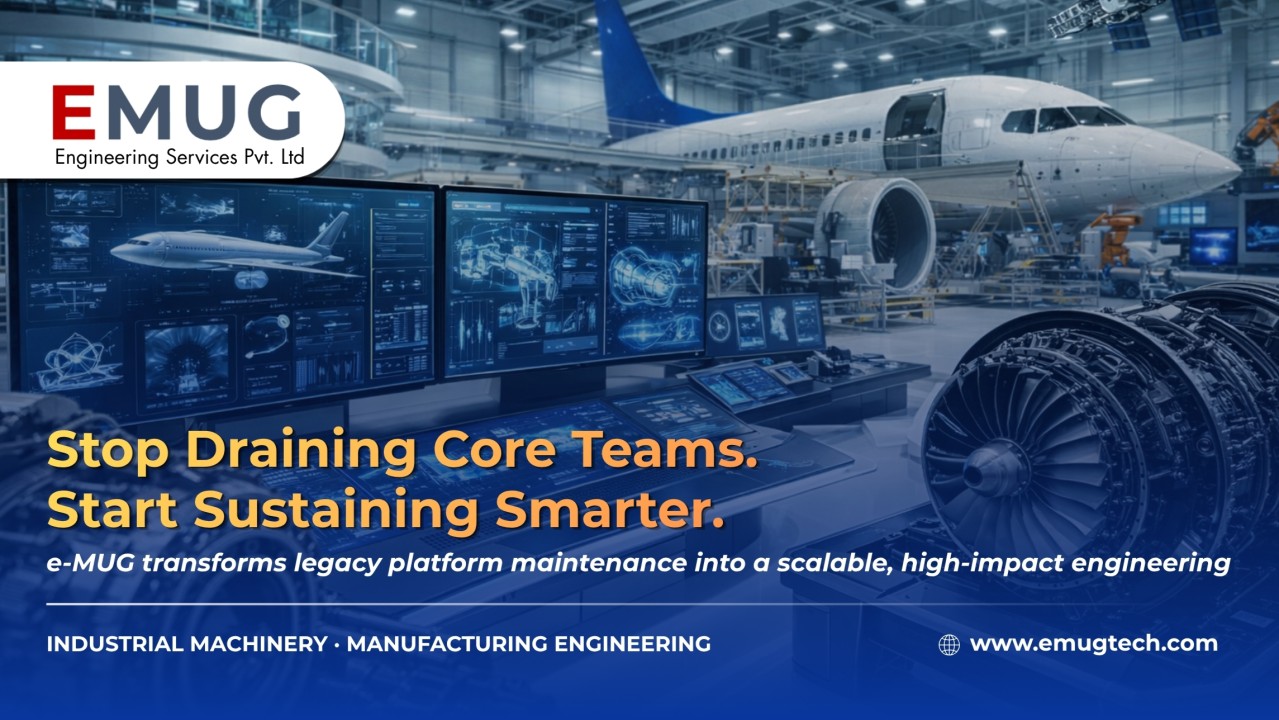
Why the most profitable engineering decision your organisation can make in 2026 isn’t a new product launch, it’s intelligently extending the revenue life of what you already built. And why e-MUG Engineering Services is the partner that makes it happen.
01. The Hidden Revenue Trap of Legacy Products
Across manufacturing, automotive, aerospace, and industrial equipment, a remarkably consistent pattern emerges: the product generating the most reliable margin is rarely the newest item on the roadmap. It is the platform that shipped three to seven years ago trusted by customers, still under service contracts, quietly generating warranty, spares, and upgrade revenue year after year.
Yet most engineering organisations structurally underinvest in these platforms. Core teams are pulled toward the next-generation program. Regulatory updates, minor feature additions, BOM optimisation, embedded software patches, and compliance re-certification get deferred until a customer escalation forces action. The result is a slow erosion of a profitable asset that took years and millions to build.

02. What Sustenance Engineering Actually Covers
Product sustenance engineering is a structured discipline, not a cleanup crew. It encompasses every technical activity required to keep a fielded product compliant, competitive, and commercially viable across its extended lifecycle. The discipline spans six core activity zones:

Beyond these activity zones, sustenance engineering increasingly overlaps with digital continuity, maintaining accurate CAD data, PLM records, test documentation, and embedded software version control so that the product can be efficiently modified, re-manufactured, or retired without catastrophic knowledge loss.
ECO Management | Legacy Code Maintenance | FMEA Updates | Spare Parts Engineering | Compliance Re-certification | CAD Data Hygiene | Firmware Version Control | DFM Re-engineering
03. The Core Team Overload Problem
The pressure is structural. Product development organisations are evaluated on new program delivery, not on how smoothly a 2019 product is sustained through its sixth year in market. When sustenance tasks compete with NPI tasks for the same engineering pool, NPI always wins because that’s where leadership attention and KPIs are focused.
“We had senior mechanical engineers spending 30% of their week on change orders for a platform“We had senior mechanical engineers spending 30% of their week on change orders for a platform that shipped four years ago. It was necessary work, but it was quietly killing our next-gen timeline.”
— Engineering Director, European Industrial Equipment OEM (composite perspective) that shipped four years ago. It was necessary work, but it was quietly killing our next-gen timeline.”
04. The e-MUG Sustenance Model: Purpose-Built for Legacy Platforms
EMUG ENGINEERING SERVICES SUSTENANCE PRACTICE
200+ domain-ready engineers. 25+ years of delivery. 6 global locations. One managed sustenance programme.
EMUG’s sustenance teams are embedded into client PLM environments from day one operating on the same CAD platforms, ECO workflows, and regulatory frameworks as the original engineering team. There is no 6–12 month ramp-up delay. e-MUG brings engineers who treat your legacy platform with the same technical rigour as your newest flagship because at e-MUG, sustenance is a career practice, not a training ground. Our global delivery model ensures your programme is never blocked by a single timezone, a single discipline gap, or a sudden workload spike.
200+ Engineers | 25+ Yrs Experience | 6 Delivery Centres | Follow-the-Sun Model | Full PLM Integration

05. PLM as the Backbone of Lifecycle Management
product cannot be sustained if its engineering data cannot be found, trusted, or modified efficiently. e-MUG’s PLM practice covering Teamcenter, Windchill, Enovia, and SAP PLM directly underpins every sustenance programme. The company provides migration solutions, CAD and PDM integrations, application management, and custom PLM extensions that ensure legacy product data stays structurally sound across years of iterative change.
When a regulatory update requires a BOM modification touching 47 part variants across three model years, the ability to trace, change, and validate that modification in a governed PLM environment is the difference between a two-week engineering change and a six-month compliance crisis. e-MUG clients don’t experience that crisis because the data infrastructure is maintained as part of the sustenance programme.
Teamcenter | Windchill | Enovia / 3DEXPERIENCE | SAP PLM | CATIA | NX | SolidWorks | Creo | Solid Edge

07 Who Should Be Reading This?
This article is written for engineering leaders, product managers, and operations heads in automotive OEMs, aerospace tier-1 suppliers, industrial equipment manufacturers, and consumer electronics companies managing products with fielded lifetimes beyond five years. If your product has a service base generating warranty, spares, or subscription revenue and your core team is sacrificing NPI velocity to sustain it the e-MUG model was designed for exactly your situation.

08 Frequently Asked Questions
Q: What is product sustenance engineering, and how does it differ from product development?
Product development creates new platforms; sustenance engineering maintains and extends the commercial viability of existing ones. Sustenance covers regulatory compliance, BOM changes, bug resolution, obsolescence management, and minor feature updates without triggering a full redesign cycle.
Q: How does e-MUG integrate with an existing client PLM environment?
EMUG engineers are trained across all major PLM systems Teamcenter, Windchill, Enovia, and SAP PLM and are onboarded directly into client environments. e-MUG provides data migration, CAD integration, and application management to ensure sustenance data remains governed and traceable.
Q: How quickly can e-MUG mobilise a sustenance team for an existing product?
For most legacy platform programmes, e-MUG can stand up a dedicated sustenance team within 4–8 weeks, leveraging pre-existing domain expertise in the client’s industry and CAD toolchain significantly faster than generalist outsourcing providers.
Q: Which industries does e-MUG serve for product sustenance programmes?
e-MUG serves automotive OEMs, aerospace tier-1 suppliers, industrial equipment manufacturers, off-highway vehicle producers, consumer appliance brands, and medical device firms any industry where products have multi-year service lives requiring structured lifecycle engineering support.
Q: Is outsourcing sustenance risky for IP-sensitive legacy platforms?
e-MUG operates under robust NDA and IP protection frameworks, secure PLM access controls, and GDPR-aligned data handling. Clients retain full IP ownership; e-MUG engineers act as an extension of the client’s engineering organisation, not as independent contractors.