01 Problem Statement: Why Industrial Equipment Fails Sooner Than It Should
Across manufacturing facilities worldwide, unplanned equipment downtime costs industrial operators an estimated $50 billion annually. Yet the root cause of most premature failures, excessive maintenance frequency, and poor serviceability in factory equipment is not operational abuse it is avoidable engineering decisions made during the original design phase.
Industrial OEMs and factory equipment manufacturers are under relentless pressure to cut first cost, compress development timelines, and ship product faster. In that environment, design choices that compromise long-term reliability and maintainability are made not through negligence, but through the absence of structured R&M engineering embedded in the development process.

The industry has a name for the engineering discipline that prevents these outcomes: Reliability, Availability, and Maintainability design or RAM. For most industrial equipment manufacturers, it is either applied too late, applied too superficially, or not applied at all. That gap is where EMUG Engineering Services delivers.
02 Solution Embedding Reliability & Maintainability into the Design Process
The solution is not a post-design audit or a checklist applied before sign-off. True reliability and maintainability engineering means changing how industrial equipment is designed from the first concept integrating failure mode thinking, service access analysis, and component standardisation as core design disciplines alongside function, performance, and cost.


03 Why EMUG Engineering Services A Consultancy Built for Industrial Machinery
EMUG Engineering Services Pvt. Ltd. has delivered industrial machinery and manufacturing equipment design support for over 25 years spanning factory automation, BIW fixture systems, CNC machine structures, special purpose machines, and heavy industrial equipment across automotive, aerospace, and process industry clients globally.
EMUG’s consultancy model is built on one principle: that engineering quality and commercial efficiency are not in conflict. By embedding experienced industrial design engineers into client programmes backed by CAE, DFM, and reliability analysis capability EMUG delivers machines that are engineered to last, engineered to be maintained, and engineered to cost less over their operating lifetime.

What sets EMUG apart from a standard design bureau is the consultancy mindset EMUG engineers ask not just ‘does this design meet the functional specification?’ but ‘will this design still be performing reliably at year 10, and can a field technician service it in under an hour?’ Those two additional questions shape fundamentally better industrial equipment.

04 R&M Design Techniques Reference Matrix for Engineering Managers
The table below maps core reliability and maintainability design techniques to their application in industrial machinery, the EMUG toolset deployed, and the measurable outcome for equipment operators. Designed as a working reference for engineering and operations decision-makers.

05 Frequently Asked Questions
Q1. At what stage in equipment development should R&M engineering be introduced?
The highest return comes from embedding R&M thinking at concept and early detailed design phase before major structural and layout decisions are locked. EMUG recommends a design-stage FMEA at concept, a maintainability access review at detailed design, and a fatigue/thermal CAE validation pass before tooling sign-off. Late-stage R&M review is still valuable but recovers a fraction of what early integration achieves.
Q2. Can EMUG support reliability engineering for fully automated production lines, not just individual machines?
Yes. EMUG’s industrial automation engineering capability covers conveyor systems, robotic cells, servo-driven assembly fixtures, and full factory line design. Reliability and maintainability principles are applied at the line level including safe-state design, diagnostic architecture, and planned maintenance access not just at the individual machine level.
Q3. How does EMUG quantify maintainability improvements in its design recommendations?
EMUG uses Mean Time To Repair (MTTR) analysis as the primary maintainability metric. Service task sequences are modelled in 3D to measure tool clearance, access time, and component removal paths producing before-and-after MTTR estimates for each critical maintenance task. This gives clients a concrete, auditable measure of improvement tied directly to design decisions.
Q4. Does EMUG’s industrial design capability extend to heavy equipment and off-highway machinery?
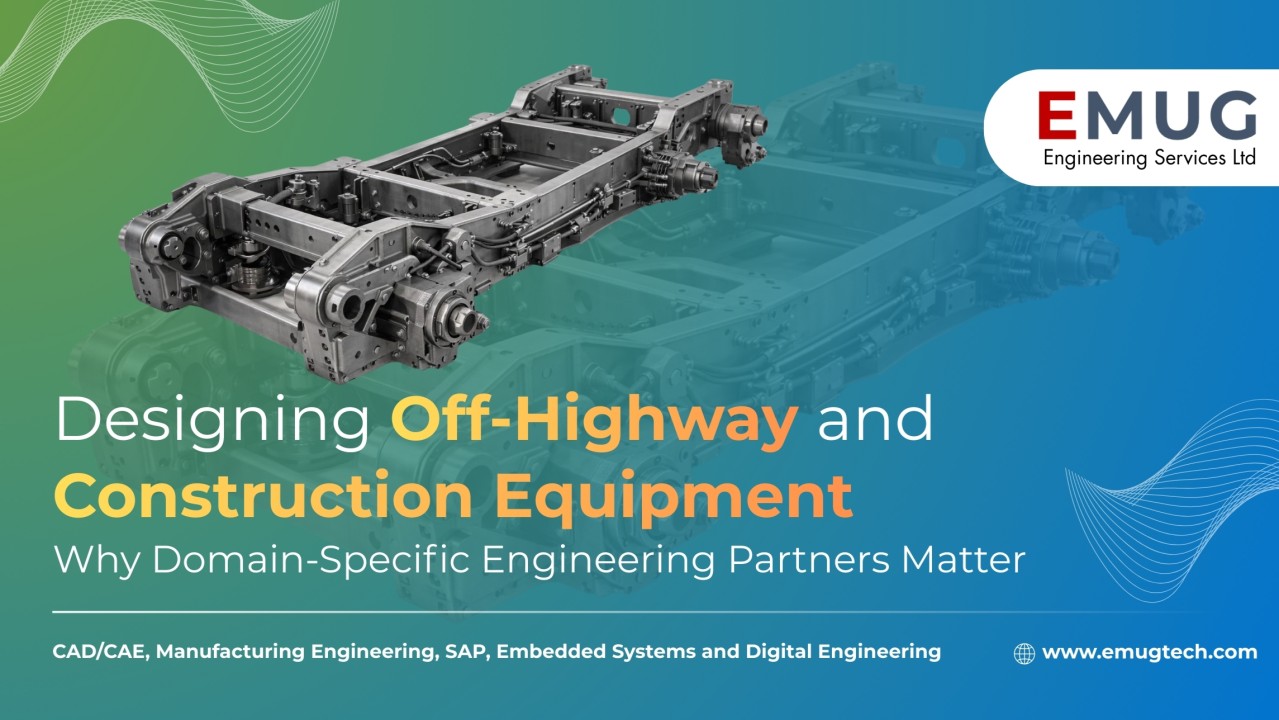
Absolutely. EMUG has experience in heavy industrial structures, off-highway machine frames, mining equipment, and agricultural machinery design alongside factory equipment. The structural analysis, fatigue, and maintainability engineering disciplines apply equally and EMUG’s teams are familiar with the higher-duty-cycle requirements and field service constraints of heavy equipment environments.
Q5. What delivery model works best for an industrial OEM engaging EMUG for the first time?
For a first engagement, EMUG typically recommends a project-based scope either a focused FMEA and maintainability review on a specific machine or subsystem, or a CAE-driven structural life assessment on an existing design. This gives both parties a clear deliverable, defined timeline, and measurable outcome to establish the working relationship before expanding to a broader programme engagement.
06 Conclusion
Industrial and factory equipment that fails too often, costs too much to maintain, or requires specialist tools and lengthy downtime to service is not a field operations problem it is a design problem. And like most design problems, it is far cheaper and faster to solve before the machine is built than after it is commissioned.
EMUG Engineering Services brings the FMEA discipline, CAE-driven life analysis, design for maintainability expertise, and manufacturing engineering depth that industrial OEMs need to produce equipment that performs as specified for its full intended life and that maintenance teams can keep running without excessive cost or complexity.
For engineering directors, product managers, and operations leaders looking to build reliability and maintainability into their industrial equipment designs from the ground up EMUG is the specialist consultancy built precisely for this challenge.